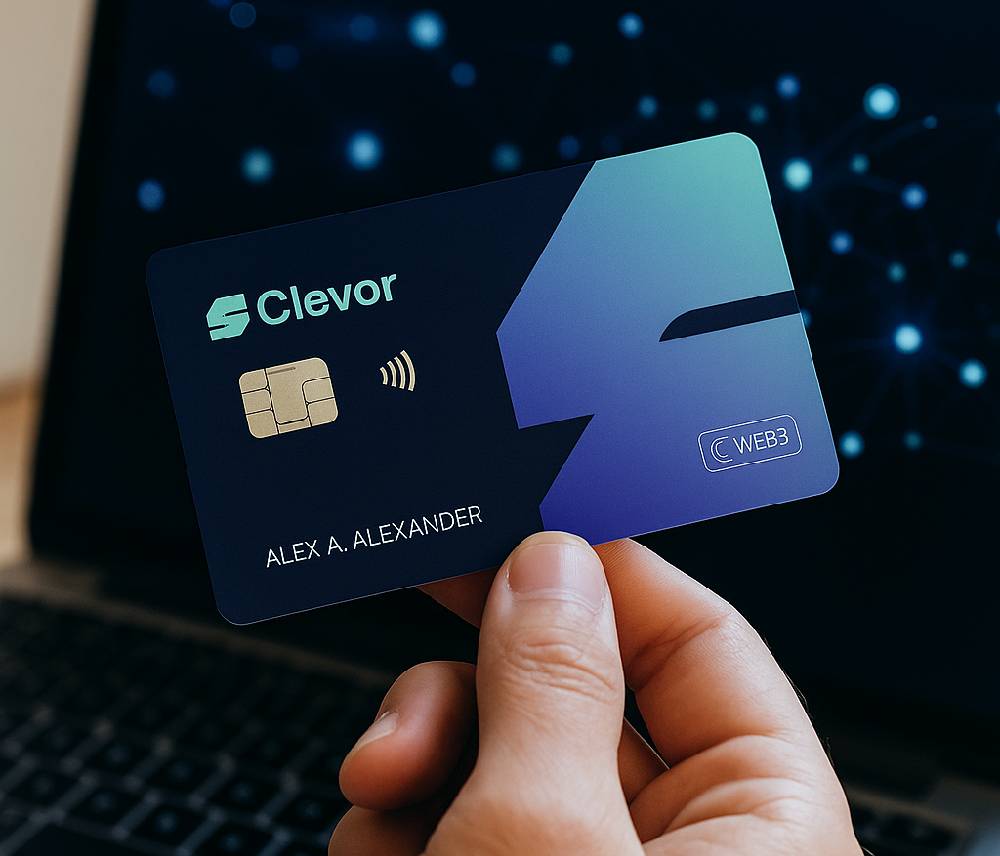
The digital finance world is continuously changing, and these two concepts are often seen as contradictory: self-custody and usability. With Web3 wallets, you are granted total ownership of your private keys; however, the use of crypto in the day-to-day remains a bit complicated. This contradiction is the reason why Clevor Cards exist. With Clevor, which integrates a Web3 Hardware Wallet, a Crypto Debit Card, and smart card security into a single device, the user receives a revolutionary solution that provides both control and convenience.
What Is a Clevor Card?
Clevor Card, basically, is a smart card, i.e., a physical, tamper-resistant device with a secure element chip. But it is more than just a payment card. In fact, it merges three advanced technologies into one single form factor: a Web3 wallet, FIDO2-based authentication, and a crypto debit card by Mastercard or Visa.
Thanks to the consolidation of these functions, Clevor is a single-device solution where private keys never leave the card, but users are able to sign blockchain transactions, authenticate themselves online without passwords, and spend crypto in normal places.
Why Use a Web3 Hardware Wallet?
Security is one of the major issues that needs to be addressed in Web3. Hardware wallets for Web3 are the safest as they keep the private keys isolated from the rest of the world in a secure hardware device. Unlike software wallets, which store the private keys on a phone or computer, Clevor’s hardware wallet is kept in the smart card’s secure element, a chip that is certified for tamper resistance.
Complete self-custody: The private keys are generated and stored in the card, and they are not on your phone or computer.
On-chain transaction signing: The Clevor Card, through the use of the smart card, signs transactions directly on the chain without exposing the keys when you are transferring funds, staking, or interacting with a DeFi protocol.
No seed phrase risk: If the card is lost, a new card with the same private key can be set up, thanks to Cryptnox cryptographic technology.
This is a security solution of cold storage that also provides the versatility of an on-chain wallet, which is a unique combination in the present crypto environment.
Spend Crypto Like Typical Money: Crypto Debit Card
The biggest challenge for crypto adoption has been the issue of spending: how to make digital assets usable for normal purchases. Clevor addresses this problem with its Crypto Debit Card.
Mastercard or Visa integration
The card is compatible with worldwide payment networks, thus enabling users to spend in any place where these are accepted.
On-chain top-up
Users may replenish their card balance directly from a Web3 wallet simply by signing a transaction; no need for intermediaries.
Instant conversion
Crypto is changed to fiat in the very moment of the transaction, thus the user gets a totally seamless experience from Web3 to the daily world of commerce.
The Clevor Card is more than just a passive asset. It’s a practical tool that you can simply keep in your wallet and use like a regular debit card.
Advanced Security: FIDO2 and Smart Card Design
Security doesn’t just stop at key storage. Besides, the card functions as a FIDO2 authenticator and, therefore, supports passwordless and phishing-resistant logins.
Passwordless access
Thanks to FIDO2, secure logins for Web3 services, exchanges, and other applications can be done without a password.
Layered security
Clevor incorporates a tamper-resistant secure element, biometric authentication, and secure communication protocols to deter any kind of assaults.
Smart card form factor
Small and sturdy like a bank card, but with an embedded, powerful crypto wallet and an authentication system.
Users receive a secure tool for signing transactions and logging into Web3 services, packed into a portable smart-card format.
How It All Works: Behind the Scenes
Below is a technical explanation of the functioning of the Clevor Card:
Initialization and Key Generation
Private keys are created on the card within a secure element when the card is activated, and the keys are never exposed outside the card.
On Chain Transaction Signing
In the event of a transaction, the Web3 wallet issues to the card an unsigned transaction, in which the card signs internally, and thus the signed transaction is returned to the wallet.
Topping Up the Card for Spending
The user of the Crypto Debit Card sends the crypto from their Web3 wallet to the card to make the card usable. The card then converts the crypto to fiat and reflects the balance.
Spending
The users can spend similarly to a regular debit card. The conversion and settlement are done discreetly by the Mastercard or Visa networks.
Authentication via FIDO2
In the case of Web3 logins, the user just needs to tap or insert the card to give permission without the requirement of a password.
Card Replacement without Seed Backup
If the card is lost, a replacement card can be issued with the same private key – no seed phrase required.
Use Cases: Which Groups Mostly Benefit from Clevor Cards
Frequent Travellers and Remote Workers
Travellers and remote workers are the main beneficiaries of Clevor Cards. Our cards enable you to do borderless transactions in real-time and also convert your cryptocurrency to fiat without the need for banks.
DeFi and Web3 Enthusiasts
The best use of this is for the interaction with dApps, signing on-chain transactions, or managing NFTs in a secure way.
Everyday Crypto Users
These include users who want to spend their crypto on groceries, online shopping, or utility bills.
Security Conscious Individuals
Doing away with the risk factors of cloud wallets and loss of seed phrases, hence, crypto remains safe, and full user control is maintained.
Summary
Clevor Cards are a fusion of a Web3 Hardware Wallet, Crypto Debit Card, and a smart card for enhanced security, allowing users to store, spend, and manage crypto securely. Our cards are compatible with passwordless logins, on-chain signing, and instant crypto-to-fiat conversion. They are perfect to use by people who travel, DeFi users, regular spenders, and security-conscious individuals looking for control and convenience.