
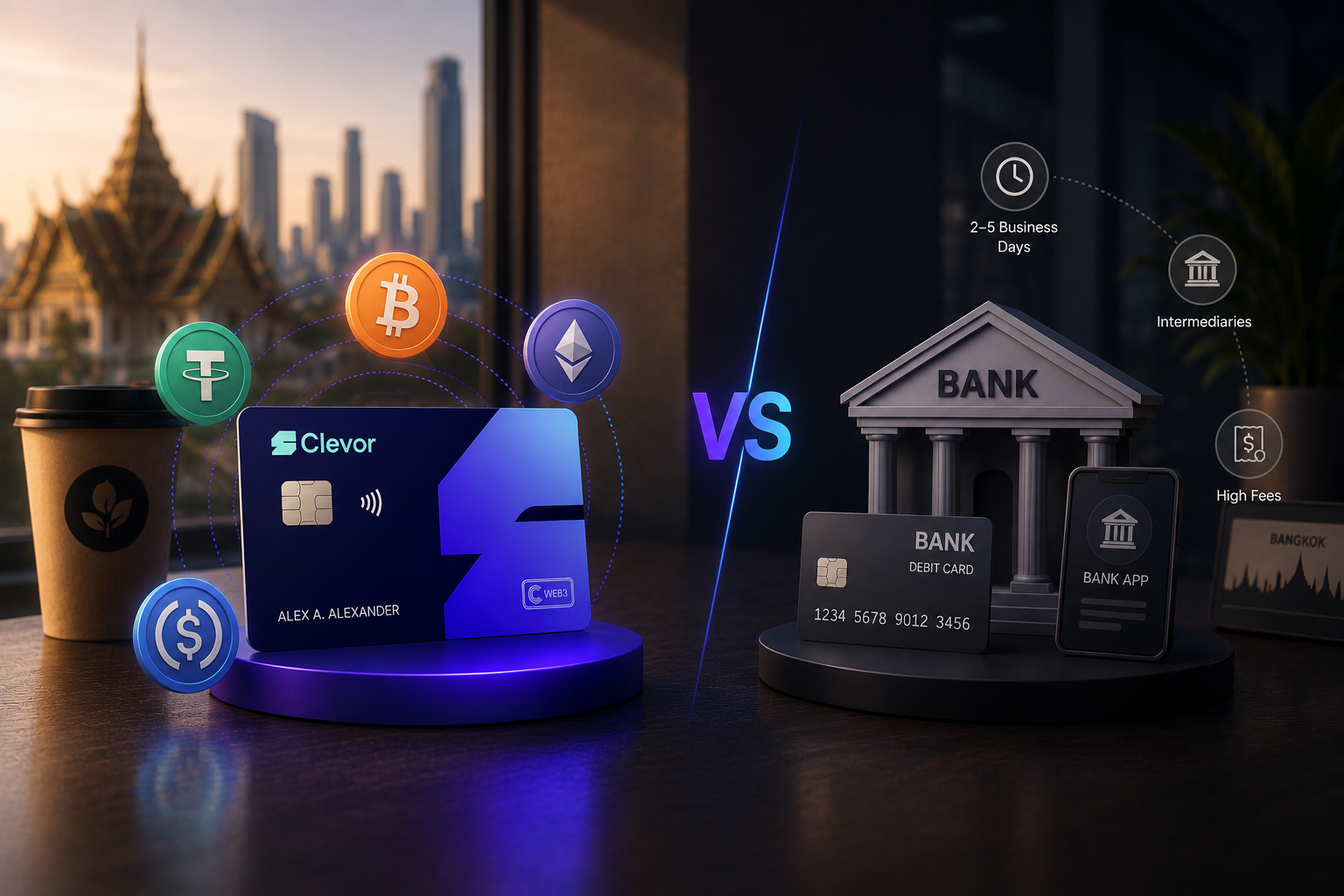
Imagine a Swiss tourist in Bangkok ordering a coffee for 120 Thai baht. At the counter, he has two possible ways to pay.
The first option is familiar. He taps a Swiss bank-issued debit card linked to his CHF bank account. The second option is newer. He scans a QR code and pays with a stablecoin such as USDT or USDC from a crypto wallet, a wallet card, or a hardware-secured payment experience such as Clevor, powered by Cryptnox C-WAAS technology.
From the customer’s point of view, both payments may feel almost identical. Tap. Scan. Approve. Leave with the coffee. But behind the scenes, the two systems are radically different.
The debit card payment is not really a single payment. It is a coordinated sequence of card authentication, merchant acquiring, international card network routing, issuer authorization, FX conversion, clearing, settlement, merchant funding, fee distribution, and accounting reconciliation. The stablecoin payment, in its simplest form, is much more direct. One signed blockchain transaction transfers value from the customer’s wallet to the merchant’s wallet.
This article compares both mechanisms in detail and counts the number of background operations required in each case. It also explains where Clevor, based on Cryptnox C-WAAS technology, fits into the stablecoin payment journey.
The Scenario: One Coffee, Two Financial Architectures
A Swiss tourist buys a coffee in Bangkok for 120 THB. He can pay in one of two ways.
| Debit card | Stablecoin | |
|---|---|---|
| Customer | Swiss tourist | Swiss tourist |
| Merchant | Coffee shop, Bangkok | Coffee shop, Bangkok |
| Price displayed | 120 THB | 120 THB converted into USDT or USDC |
| Funding source | Swiss CHF bank account | USDT or USDC wallet balance |
| Payment instrument | Swiss bank-issued debit card | Crypto wallet or Clevor Card |
| Settlement asset | Fiat money through banking rails | Stablecoin token on blockchain |
| Merchant receives | THB in bank account, after settlement | USDT/USDC directly, or THB after off-ramp |
The visible action is simple in both cases. The hidden architecture is not.
Part 1 — Paying with a Swiss Debit Card in Bangkok
What the customer sees
The Swiss tourist taps his debit card. The terminal says: Approved. The tourist leaves with the coffee. To him, the transaction is finished. But in the card payment system, the story is only beginning.
What really happens in the background
A Swiss debit card payment in Bangkok involves the cardholder, the Bangkok coffee shop, the merchant’s POS terminal, the merchant processor, the Thai acquiring bank, the international card network, the Swiss issuing bank, the issuer processor, FX systems, settlement banks, and reconciliation and accounting systems.
The cardholder experiences one tap. The financial system sees a cross-border, multi-currency, multi-party transaction.
Full debit card operation count
| # | Background operation |
|---|---|
| 1 | Merchant enters or selects the coffee price in THB. |
| 2 | POS terminal prepares the card payment request. |
| 3 | Card is tapped, inserted, or presented to the reader. |
| 4 | EMV chip or contactless application is read. |
| 5 | Card and terminal perform cryptographic checks. |
| 6 | Card generates transaction authentication data. |
| 7 | Terminal builds an authorization request. |
| 8 | Merchant processor receives the transaction. |
| 9 | Thai acquiring bank or payment processor identifies the merchant. |
| 10 | Acquirer performs basic merchant, terminal, and risk checks. |
| 11 | Acquirer routes the transaction to the relevant card scheme. |
| 12 | Card network identifies the Swiss issuer using the card BIN or IIN. |
| 13 | Card network applies cross-border routing rules. |
| 14 | Authorization request is sent internationally to the Swiss issuer or issuer processor. |
| 15 | Swiss issuer validates card status. |
| 16 | Swiss issuer checks whether the card is blocked, expired, or restricted. |
| 17 | Issuer validates transaction cryptogram or EMV authentication data. |
| 18 | Issuer performs fraud scoring based on country, merchant category, velocity, amount, and history. |
| 19 | Issuer checks available funds in the customer’s CHF account. |
| 20 | Issuer estimates the THB-to-CHF amount using card-network FX logic or internal pricing. |
| 21 | Issuer may add foreign transaction fees or markup. |
| 22 | Issuer places an authorization hold on the customer’s account. |
| 23 | Issuer generates approval or decline response. |
| 24 | Response travels back through the card network. |
| 25 | Response reaches the Thai acquirer. |
| 26 | Acquirer forwards the approval to the merchant terminal. |
| 27 | Terminal displays “Approved.” |
| 28 | Merchant POS records the sale. |
| 29 | Merchant closes or batches transactions later in the day. |
| 30 | Acquirer receives the merchant’s batch file. |
| 31 | Acquirer submits clearing data to the card network. |
| 32 | Card network calculates interchange, scheme fees, cross-border fees, and settlement amounts. |
| 33 | Card network sends clearing presentment to the Swiss issuer. |
| 34 | Issuer matches the clearing file with the original authorization. |
| 35 | Issuer converts the transaction into the final CHF debit. |
| 36 | Issuer releases or adjusts the original authorization hold. |
| 37 | Issuer posts the final transaction to the customer’s bank account. |
| 38 | Cardholder receives an account entry, push notification, or statement line. |
| 39 | Card network calculates net settlement positions between members. |
| 40 | Swiss issuer funds its side of the scheme settlement. |
| 41 | Scheme settlement credits the acquiring side. |
| 42 | Thai acquirer receives settlement value. |
| 43 | Acquirer deducts merchant service charges. |
| 44 | Acquirer credits the merchant’s bank account in THB. |
| 45 | Merchant reconciles the POS transaction with the bank deposit. |
| 46 | Merchant accountant records the sale, fees, VAT or tax treatment, and bank settlement. |
| 47 | Transaction remains subject to disputes, reversals, refunds, or chargeback processes. |
Part 2 — Why the Debit Card Payment Is So Complex
The Swiss debit card works in Bangkok because many institutions agree to trust each other. The Bangkok coffee shop does not know the Swiss tourist. The Thai acquirer does not hold the tourist’s Swiss bank account. The Swiss issuing bank does not know the coffee shop. Yet the system makes the coffee shop confident that it will eventually be paid. That trust is created through layers of infrastructure.
1. Authorization is not settlement
When the terminal says “Approved,” the merchant has not necessarily received the money. The issuer has approved the transaction and placed a hold on the customer’s funds. The actual clearing, settlement, and merchant funding happen later. This is fundamental to card payments: the customer experience is instant, but settlement is delayed and multi-step.
2. The payment is cross-border
The coffee shop is in Thailand. The customer’s bank is in Switzerland. The transaction must travel internationally through card network infrastructure, issuer systems, acquirer systems, and settlement systems.
3. There is foreign exchange
The coffee is priced in THB. The tourist’s bank account is in CHF. Somewhere in the process, the card transaction must be converted from Thai baht into Swiss francs. This may involve card network exchange rates, issuer exchange rates, foreign transaction fees, FX markup, and final posting adjustments. The customer may not know the exact final CHF amount at the moment of tapping the card.
4. There are multiple ledgers
At minimum, the transaction touches the merchant POS ledger, the Thai acquirer ledger, the card network clearing system, the Swiss issuer ledger, the Swiss customer bank account ledger, and the merchant bank account ledger. Each ledger must eventually agree with the others.
5. Complexity provides protection
This complexity is not useless. The card system provides global acceptance, fraud monitoring, cardholder protection, dispute procedures, refunds and chargebacks, merchant underwriting, terminal certification, and regulated bank account integration.
Part 3 — Paying with USDT or USDC
What the customer sees
Now imagine the same coffee shop also accepts stablecoins. The merchant displays a QR code. The Swiss tourist scans it with a wallet, a secure wallet card, or a Clevor-style card-based wallet experience. The wallet shows the amount — for example, 3.30 USDC. The tourist confirms. The transaction is signed and broadcast to the blockchain. After confirmation, the merchant sees the payment.
The simplest stablecoin payment model
In the cleanest version, the coffee shop accepts USDT or USDC directly and keeps the stablecoin. There is no card issuer. No acquiring bank. No card network. No international card clearing file. No card scheme settlement. No merchant acquirer funding delay. There is simply a transfer of digital value from one wallet to another.
Full stablecoin operation count — direct payment
| # | Background operation |
|---|---|
| 1 | Merchant creates a payment request or QR code. |
| 2 | Merchant converts the THB coffee price into a USDT or USDC amount. |
| 3 | Customer wallet reads the payment request. |
| 4 | Wallet checks token balance and network compatibility. |
| 5 | Wallet prepares a blockchain transaction. |
| 6 | Customer signs the transaction with a private key, wallet, or hardware wallet. |
| 7 | Wallet broadcasts the transaction to the blockchain network. |
| 8 | Validators or block producers include the transaction in a block. |
| 9 | Blockchain state updates: customer token balance decreases and merchant token balance increases. |
| 10 | Merchant wallet or payment app detects the incoming transaction. |
| 11 | Merchant marks the invoice as paid. |
| 12 | Merchant accounting records the sale and the stablecoin asset value. |
Part 4 — Where Clevor Fits in Stablecoin Payments
Clevor is positioned between the user and the blockchain payment. It provides the secure user experience layer that makes self-custodial stablecoin payments practical for everyday spending. Clevor is based on Cryptnox C-WAAS technology — Card Wallet as a Service — combining a card-based wallet experience, hardware-secured private key management, and on-chain transaction signing.
1. Clevor can secure the stablecoin wallet
A normal software wallet keeps private keys on a phone or in a software environment. A Clevor-style wallet uses Cryptnox hardware wallet technology so that private keys are protected by a secure element and transactions are signed in a hardware-secured environment. Stablecoin payments are final — if the private key is compromised, funds can be lost. Clevor helps by making the stablecoin wallet more like a secure payment instrument.
2. Clevor can make on-chain payments feel like card payments
Most consumers do not want to think about gas, chains, contract addresses, or transaction signing. They want a simple experience: see amount, approve payment, authenticate, pay. Clevor can abstract the stablecoin payment experience while keeping the core benefit of blockchain settlement.
3. Clevor can support multiple payment modes
- Route A — Direct stablecoin payment: The customer pays the merchant directly in USDT or USDC. Best for merchants, apps, or platforms that accept stablecoins directly.
- Route B — Stablecoin payment with merchant off-ramp: The customer pays in USDT or USDC, the merchant converts to THB or another fiat currency. Best for merchants who want local fiat settlement.
- Route C — Crypto debit card route: The user spends from stablecoin balances, but the merchant receives a traditional card payment. Best for existing merchants that do not yet accept stablecoins.
Part 5 — What If the Merchant Wants THB?
The direct stablecoin model is extremely simple if the coffee shop is happy to receive and hold USDT or USDC. But most coffee shops in Bangkok pay rent, salaries, suppliers, and taxes in Thai baht. If the merchant wants THB in a bank account, the stablecoin payment requires an off-ramp.
Full stablecoin operation count — with THB off-ramp
| # | Background operation |
|---|---|
| 1 | Merchant creates a payment request or QR code. |
| 2 | Merchant converts the THB coffee price into a USDT or USDC amount. |
| 3 | Customer wallet reads the payment request. |
| 4 | Wallet checks token balance and network compatibility. |
| 5 | Wallet prepares a blockchain transaction. |
| 6 | Customer signs the transaction. |
| 7 | Wallet broadcasts the transaction to the blockchain. |
| 8 | Validators or block producers include the transaction in a block. |
| 9 | Blockchain state updates balances. |
| 10 | Merchant wallet or payment app detects the incoming transaction. |
| 11 | Merchant marks the invoice as paid. |
| 12 | Merchant or payment processor sends the stablecoin to an exchange, broker, or off-ramp provider. |
| 13 | Stablecoin is sold for THB or another fiat settlement currency. |
| 14 | Off-ramp provider performs liquidity, compliance, and payout checks. |
| 15 | Fiat payout is initiated through local banking rails. |
| 16 | Merchant receives THB in its bank account. |
| 17 | Merchant reconciles stablecoin receipt, exchange rate, fees, and fiat payout. |
| 18 | Merchant accountant records the sale, stablecoin conversion, fees, and final THB settlement. |
Part 6 — Total Operation Count Comparison
Part 7 — Pure Clearing and Settlement Comparison
There is an even sharper comparison: the number of operations required purely for clearing and settlement. A debit card payment is first an authorization message. Settlement happens later. A stablecoin transfer is already a settlement operation. Once confirmed on-chain, the value has moved from the payer’s wallet to the merchant’s wallet.
Debit card — pure clearing and settlement
| # | Pure clearing / settlement operation |
|---|---|
| 1 | Merchant closes the transaction batch. |
| 2 | Merchant processor sends the batch to the Thai acquirer. |
| 3 | Thai acquirer submits the transaction to the card scheme for clearing. |
| 4 | Card scheme identifies the Swiss issuer and prepares clearing presentment. |
| 5 | Card scheme calculates interchange, scheme fees, cross-border fees, and settlement currency amounts. |
| 6 | Card scheme applies the relevant FX conversion logic between THB and CHF. |
| 7 | Swiss issuer receives and matches the clearing transaction against the earlier authorization. |
| 8 | Swiss issuer posts the final CHF debit to the cardholder account. |
| 9 | Swiss issuer funds its settlement obligation to the card scheme or settlement bank. |
| 10 | Card scheme nets settlement positions between issuers and acquirers. |
| 11 | Settlement value is credited to the Thai acquiring side. |
| 12 | Thai acquirer deducts merchant service charges and other acquiring fees. |
| 13 | Thai acquirer funds the merchant’s bank account in THB. |
| 14 | Merchant receives the bank credit and reconciles it with the original sale. |
Direct stablecoin — pure clearing and settlement
| # | Pure clearing / settlement operation |
|---|---|
| 1 | Customer signs and broadcasts one stablecoin transaction that transfers value from the customer wallet to the merchant wallet. The blockchain transaction performs the role of both clearing and settlement. |
Stablecoin with THB off-ramp — pure clearing and settlement
| # | Pure clearing / settlement operation |
|---|---|
| 1 | Customer sends USDT or USDC to the merchant wallet or payment processor wallet. |
| 2 | Stablecoin transaction is confirmed on-chain. |
| 3 | Merchant or processor converts the stablecoin into THB. |
| 4 | Off-ramp provider initiates fiat payout through local banking rails. |
| 5 | Merchant receives THB in its bank account. |
| 6 | Merchant reconciles stablecoin receipt, FX conversion, fees, and bank payout. |
Part 8 — Updated Comparison Tables
Total background operations
| Payment model | Operations |
|---|---|
| Swiss debit card payment in Bangkok | 47 |
| Direct USDT/USDC wallet payment | 12 |
| USDT/USDC payment with THB off-ramp | 18 |
Pure clearing / settlement operations
| Payment model | Operations |
|---|---|
| Swiss debit card payment in Bangkok | 14 |
| Direct USDT/USDC wallet payment | 1 |
| USDT/USDC payment with THB off-ramp | 6 |
Part 9 — Why Stablecoin Payments Feel Structurally Different
The ledger is shared
In the card world, each participant has its own ledger. The issuer has one version of the transaction. The acquirer has another. The card network has clearing records. In the blockchain world, the transaction is recorded on a shared ledger. The payer, merchant, wallet provider, and auditor can all refer to the same transaction hash.
Settlement is native to the payment
A card authorization is a promise that money should move later. A blockchain transfer is the movement itself. The payment instruction and the settlement record are compressed into a single operation.
There is no card issuer in the middle
With a debit card, the Swiss issuer decides whether to approve the transaction. With a self-custodial stablecoin wallet, the user authorizes the transaction directly by signing it. The blockchain validates the signature and state transition.
There is no native chargeback layer
Stablecoin payments can be final and simple. But if the customer sends funds to the wrong address, overpays, or is defrauded, there is no native card-style chargeback mechanism. Refunds must be handled by a separate transaction. This is both a benefit and a limitation.
Part 10 — The Fair Comparison: Complexity vs Guarantees
It would be wrong to say that the debit card system is simply bad because it is complex. The card system provides valuable guarantees:
- Global acceptance
- Fraud monitoring
- Cardholder protection
- Dispute procedures and chargebacks
- Merchant underwriting
- Regulated bank account integration
- Familiar statements and accounting
The stablecoin model provides different advantages:
- Direct settlement
- Fewer intermediaries
- 24/7 operation
- Programmable payment logic
- Global wallet-to-wallet transfer
- Transparent transaction record on a shared ledger
- No card scheme clearing cycle
- Simpler cross-border digital value movement
Clevor sits in the middle of this evolution. It can help bridge self-custodial wallets, stablecoin payments, and traditional real-world spending.
Part 11 — Where Stablecoin Complexity Comes Back
Stablecoin payments are simple at the transfer layer, but complexity can return at the edges.
Onboarding
The customer must already have USDT or USDC. If the customer buys stablecoins through a bank, exchange, or card, that acquisition process may involve KYC, fees, bank transfers, or card payment rails.
Gas fees
Most blockchains require transaction fees. For small retail payments such as coffee, this is why merchants often prefer low-fee networks, high-throughput blockchains, or layer-2 networks.
Merchant accounting
The coffee shop must account for the sale, the stablecoin value, any exchange gain or loss, and local tax obligations.
Fiat conversion
If the merchant wants THB, an off-ramp is needed. That off-ramp reintroduces exchanges, bank accounts, liquidity providers, compliance checks, and reconciliation.
Compliance
A regulated payment provider may still need wallet screening, sanctions checks, transaction monitoring, and reporting.
Conclusion: One Coffee, Two Financial Architectures
A Swiss tourist buying a coffee in Bangkok with a Swiss bank-issued debit card triggers a surprisingly large financial machine. The background process can involve around 47 background operations, or 14 pure clearing and settlement operations.
A direct stablecoin payment is structurally different. The full direct stablecoin payment flow involves around 12 practical operations — with the clearing and settlement event being just 1 blockchain transaction. If the merchant converts to Thai baht, the process rises to around 18 total operations and 6 pure clearing and settlement operations.
Clevor, powered by Cryptnox C-WAAS technology, can help make that simpler settlement model usable in the real world — combining hardware-secured self-custody, card-based usability, stablecoin transaction signing, and optional bridges to fiat spending.
Card payments separate authorization, clearing, settlement, FX, and merchant funding across many institutions. Stablecoin payments compress clearing and settlement into a single ledger update. A debit card hides complexity behind a simple tap. A stablecoin payment exposes a simpler settlement model: sign once, broadcast once, settle once.
Related reading: Blockchain payments vs credit cards and crypto debit card vs multi-technology smart card.